
 English
  Tiếng Việt
 日本語
日本語Celebrating the 80th anniversary of the National Resistance War: Awakening the spirit of self-reliance and self-reliance in the new era
After the victory of the August Revolution in 1945, Vietnam entered an era of independence and freedom, but the young revolutionary government faced many serious difficulties both at home and abroad.
The consequences of the famine from late 1944 to early 1945 left more than two million people dead, over 90% of the population illiterate, while the Central treasury had only more than 1.2 million VND left. 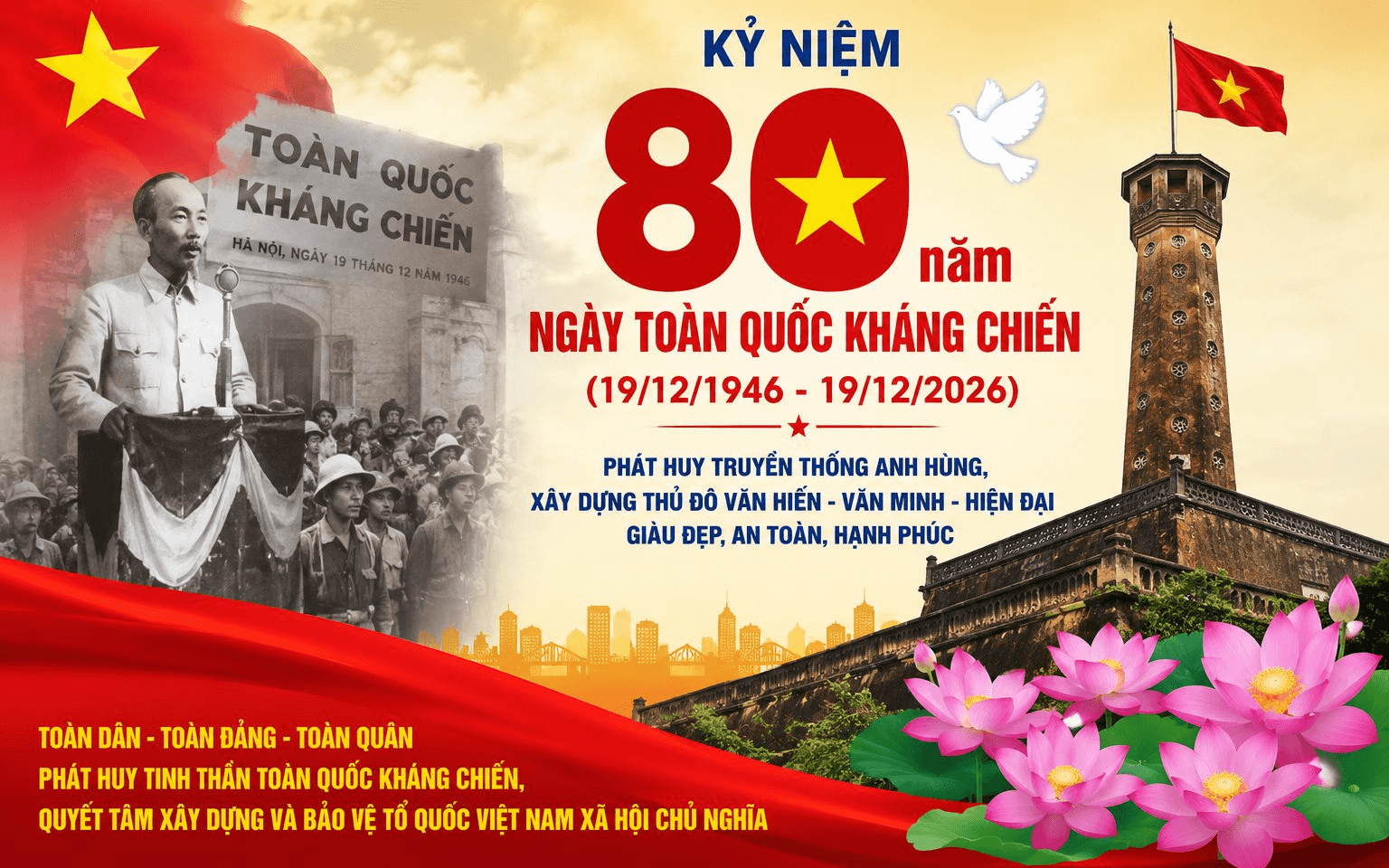 Outside, about 200,000 troops of the Republic of China entered the North of the 16th parallel. In the South, with the support of British troops, the French colonialists opened fire to capture Saigon on September 23, 1945, opening the second war of invasion in Vietnam. Faced with that situation, the Party and President Ho Chi Minh implemented a policy of peace to protect the newly won independence, take advantage of time to strengthen forces and prepare for more difficult situations. From the Directive “Resistance to National Construction” dated November 25, 1945, Vietnam in turn signed with France the Preliminary Agreement on March 6, 1946 and the Provisional Agreement on September 14, 1946 with the goal of preserving peace and extending the preparation time. However, tensions escalated as the French army continuously violated the agreements. In November 1946, France attacked Hai Phong and Lang Son. On December 15 and 16, provocative actions continued to take place in Hanoi, before the massacre on Hang Bun Street and Yen Ninh Street on December 17. On December 18 and the morning of December 19, 1946, France sent an ultimatum demanding to disarm the self-defense forces and police, and announced that it would take action no later than the morning of December 20. Faced with that situation, on December 18 and 19, 1946 in Van Phuc, Ha Dong, the Party Central Committee held an expanded meeting under the chairmanship of President Ho Chi Minh and decided to launch a resistance war against the French colonialists nationwide. On the afternoon of December 19, 1946, Minister of Defense Vo Nguyen Giap issued a secret order for a general attack. At exactly 20:00 on the same day, artillery at Lang Fort opened fire, Hanoi’s soldiers and people simultaneously opened fire, starting the nationwide resistance war. On the morning of December 20, 1946, President Ho Chi Minh’s call for national resistance was transmitted on the radio, expressing determination to protect the nation’s independence. Responding to the call, the capital’s troops and people entered 60 days and nights of fighting with the spirit of “Determining death to let the Fatherland decide to live”. During this time, our forces have carried out nearly 200 battles, destroyed nearly 2,000 enemy soldiers, and destroyed more than 100 military vehicles, including 22 tanks and armored vehicles; shot down and destroyed 5 planes, sank 2 canoes. The fighting in Hanoi and the cities north of the 16th parallel contributed to holding back the French forces, creating conditions for the headquarters to move safely to the Viet Bac base, preparing for a long-term resistance war. On the basis of the policy of all-people, comprehensive, long-term resistance and relying primarily on one’s own strength, the Vietnamese army and people continue to win many important victories. The Viet Bac Autumn – Winter campaigns in 1947, Border in 1950, Hoa Binh in the period of 1951 – 1952, Northwest in 1952 and Upper Laos in 1953 gradually changed the relationship on the battlefield. The pinnacle was the Dien Bien Phu Victory in 1954 after 56 days and nights of fighting, leading to the signing of the Geneva Accords, successfully ending the resistance war against the French colonialists. The spirit of self-reliance and self-reliance continues to be promoted in the struggle for national unification. During the 21 years from 1954 to 1975, Vietnam simultaneously carried out the task of building socialism in the North and carrying out the people’s national democratic revolution in the South. The Vietnamese army and people successively overcame war strategies, from the “Special War” in the period 1961 – 1965 to the “Local War” in the period 1965 – 1968 and “Vietnamization of the war”. The General Offensive and Uprising in the Spring of Mau Than in 1968, the fight against strategic raids by B-52 in Hanoi and Hai Phong in 1972 and the Paris Agreement in 1973 continued to create important changes. The great victory in the Spring of 1975, ending with the Ho Chi Minh Campaign, completed the cause of liberating the South and unifying the country. After the war, Vietnam continued to face many economic difficulties and a state of siege and embargo. The Doi Moi initiative initiated in 1986 opened a new phase of development. According to the article, by 2025, the scale of Vietnam’s economy will reach 514 billion USD, ranking 32nd in the world, while GDP per capita will reach 5,026 USD. The urbanization rate reached 45%, the Human Development Index reached 0.766 points, the Happiness Index ranked 46th out of 143 countries, the multidimensional poverty rate decreased to 1.3%, the health insurance coverage rate reached 95.2% and the average life expectancy reached 74.8 years. In the field of foreign affairs, Vietnam has established diplomatic relations with 194 United Nations member countries, while expanding its network of partnership frameworks. Towards the 80th anniversary of the National Resistance Day, many large-scale activities are expected to be held in 2026. The national celebration will take place on December 19, 2026 in Hanoi, with the coordination of the Party Central Committee, the National Assembly, the President, the Government, the Central Committee of the Vietnam Fatherland Front and Hanoi city. In addition to the celebration, there are also activities to pay tribute to historical witnesses and people with meritorious service, a national scientific conference hosted by the Ministry of Defense and a symposium conducted by the University of Social Sciences and Humanities. Many cultural, media and historical education activities are also implemented, including competitions for learning and creating art, publishing books about the event, releasing a set of special postage stamps, and documentary and animated film products. Through a series of commemorative activities, the values of the National Resistance Day continue to be introduced to today’s generations, especially the spirit of solidarity, self-reliance, self-reliance and responsibility towards the country. From the historical milestone in December 1946 to the current development journey, the spirit of overcoming difficulties and the desire to rise continue to be emphasized as a resource contributing to promoting socio-economic development goals in the period 2026 – 2030.