
 English
  Tiếng Việt
 日本語
日本語The book suggests thinking and ways of working in the age of artificial intelligence
With nearly 200 pages, “Digital Officer – Digital Civil Servant” is built as a handbook on thinking and working skills in the context of artificial intelligence increasingly appearing in the workplace environment.
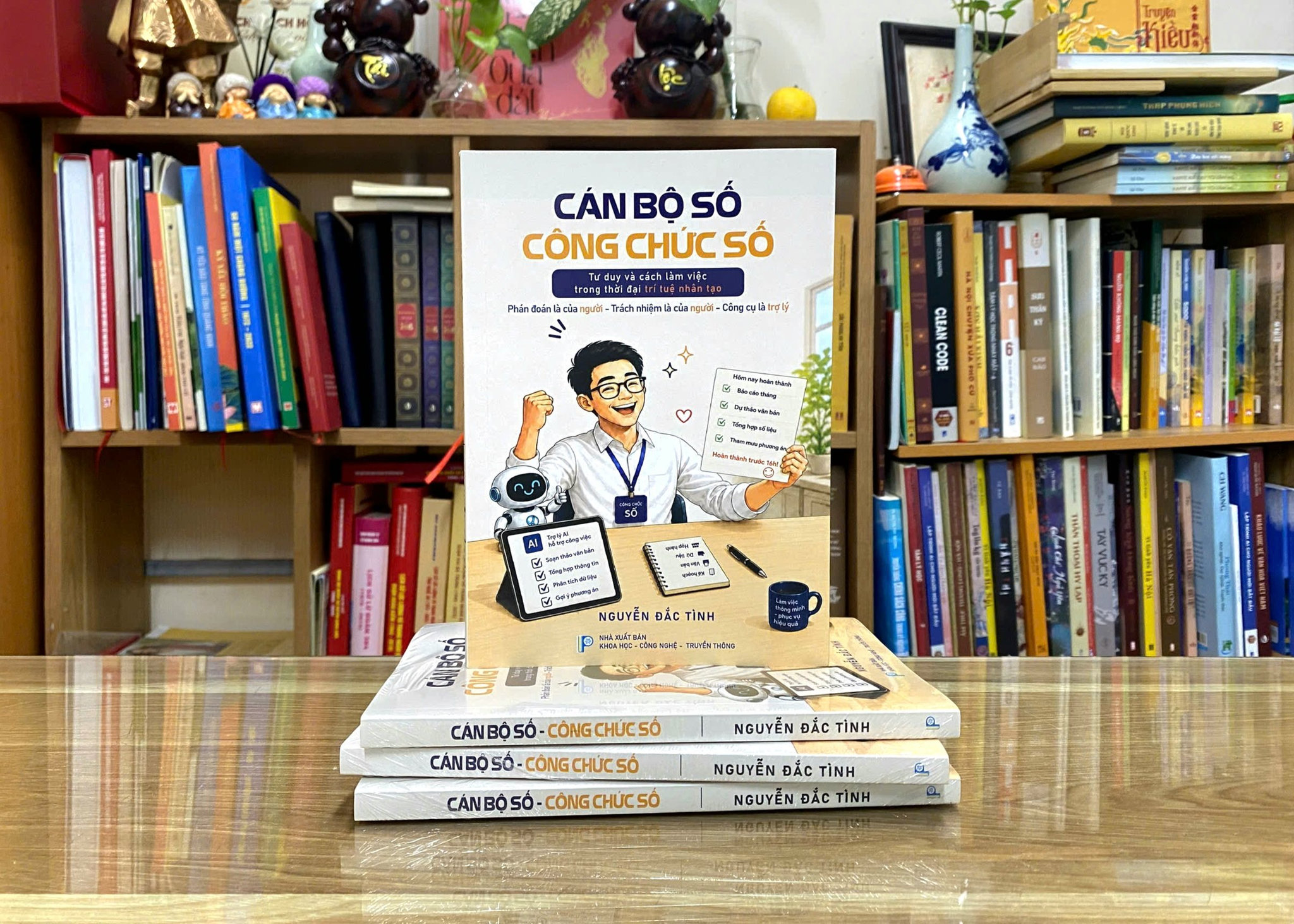
From the beginning, author Nguyen Dac Tinh determined that the book does not follow the direction of instructions for using AI with specific operations such as which buttons to press, what commands to enter, or how to select features. Instead of focusing on tools that can quickly change over time, the book’s content directs readers to more fundamental and long-term issues such as how to determine job requirements, clearly visualize the output product, check the accuracy of information, protect data and take responsibility for the results created. From the fact that AI has become increasingly present in the working environment, the author identifies two common trends. A part chooses to avoid technology, continuing to handle work in the traditional way; Meanwhile, in the opposite direction, some people are too dependent on AI, using machine-generated content almost as is without performing the necessary checks. Instead of leaning towards one of these two approaches, the author recommends a more balanced approach. AI can help people synthesize data, edit documents and process information faster, thereby significantly reducing work pressure. A document can be created by AI in just a few minutes, but whether the content is accurate, appropriate to the context, or meets the job requirements still requires human judgment. A consistent message emphasized in the book is that just because AI creates a product does not mean that AI is responsible for that product. Technology users are still the ones who must check and compare information and make the final decision on whether to use AI-powered results or not. The book also builds a roadmap with 5 levels: citizen, digital citizen, digital officer, digital manager and digital leader. This division helps readers easily visualize their position in the process of adapting to the digital environment. Accordingly, it is not necessary for everyone to immediately aim for the highest level, but more importantly, determine where they are and how technology can better support their current work. Along this roadmap are six core principles related to accountability, mindset, speed, verification, data and process. This is also a group of content built by the author in a way that is not dependent on a specific software or AI version, thereby having the ability to maintain value even when technology continues to change rapidly. Author Nguyen Dac Tinh has more than 20 years working in the field of technology and AI research. From the beginning of 2026, he moved to work at a specialized state management agency of Hanoi city, directly participating in work related to science, technology, innovation, digital transformation and information security. Along with that are the tasks of consulting, synthesizing and processing documents in the administrative environment. The author’s accumulated experiences while working in both the technology and administrative fields are distilled into the content of the book. It is the transition between these two environments that creates a unique perspective for “Digital Officer – Digital Civil Servant”. AI issues are not only approached from a technical perspective, but also placed in specific work situations such as synthesizing information, making reports, making statistics, drafting and reviewing documents. However, because it originates mainly from practical administrative work, the book’s content focuses more on the level of work implementation and management. Issues at the policy and strategic level are mentioned less frequently. However, with the orientation towards changing working habits from daily tasks, this is still a suitable approach for the readers the book is aimed at. In a context where machines are increasingly capable of processing large volumes of information at high speeds, the role of humans is not shrinking. On the contrary, human value is more clearly shown in the ability to ask the right questions, identify the right problem, verify information and take responsibility for the final decision. The principles of using AI responsibly, ensuring the accuracy of information and building reasonable work processes mentioned in the book are not only suitable for administrative areas but can also be applied in many other working environments, where AI is gradually becoming a familiar tool in daily work.